The Revolution That Started in Paris
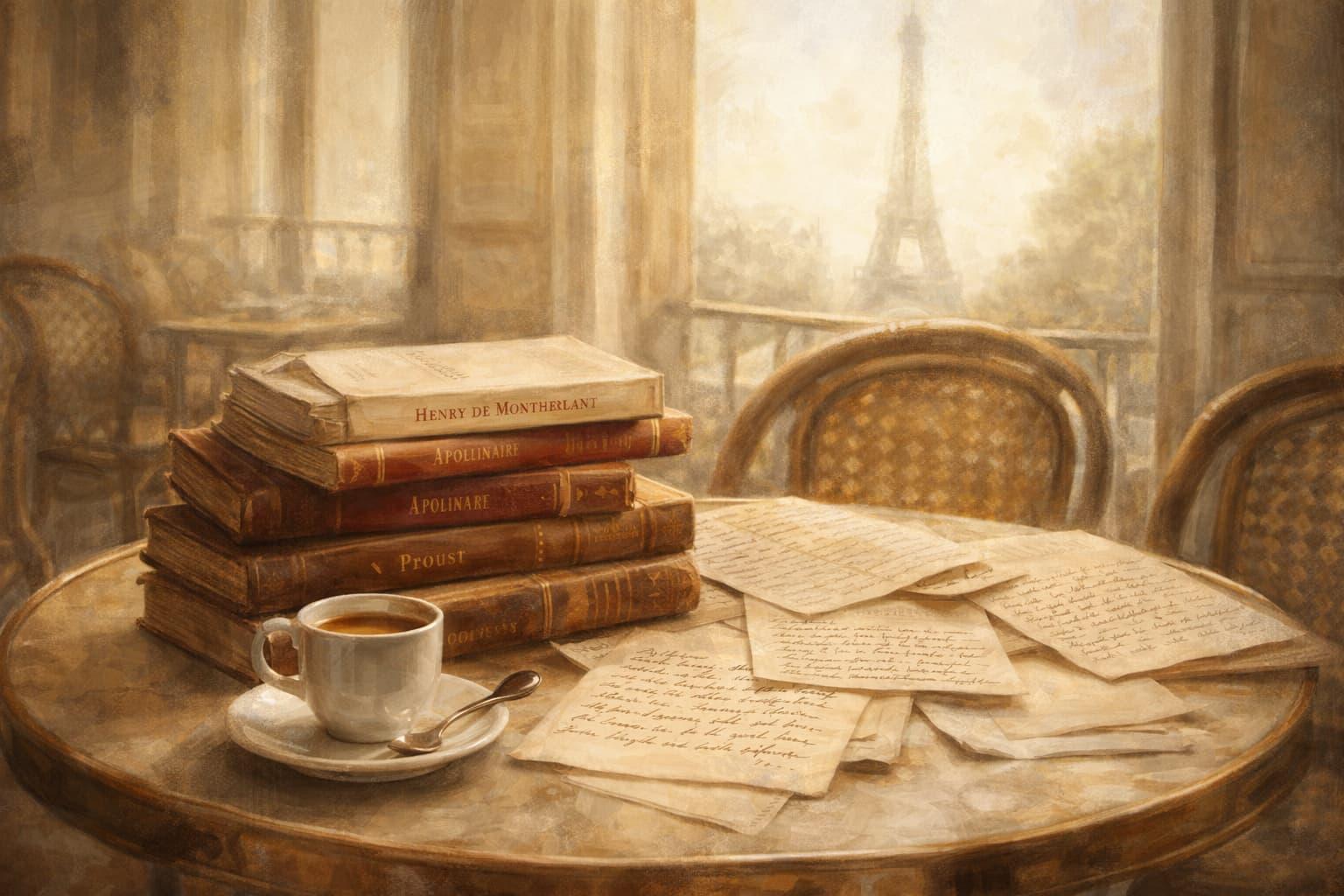
Sometime around 1910, the French novel broke. Not accidentally — deliberately. A generation of writers looked at the tidy, well-plotted fiction of the nineteenth century and decided it was a lie. Real life didn't have clean narratives. Real consciousness didn't move in straight lines. Real people didn't think in complete sentences.
What followed was one of the most explosive periods in literary history. In the space of about thirty years, French writers reinvented the novel from the ground up. They shattered chronology, abandoned conventional plot, blurred the line between fiction and autobiography, and wrote sentences that went on for pages — or stopped in the middle of a word.
These books can be difficult on the page. The experimental techniques that make them revolutionary can also make them exhausting to read. But as audiobooks, something remarkable happens: the difficulty dissolves. Prose that seems impenetrable in print reveals its rhythm and logic when spoken aloud. These writers were, in many ways, closer to oral storytelling than to traditional literature. Their work was meant to be experienced as a flow of consciousness — and that's exactly what a narrator provides.
French Modernism
Bold, experimental works from early twentieth-century France that broke every literary convention of their time.
Browse collection →André Gide and the Novel That Devoured Itself
André Gide spent decades circling around the question that obsessed him: can a person be authentic? His early works are elegant but restrained. Then, in 1925, he published The Counterfeiters and blew the doors open.
The novel follows a group of Parisian schoolboys involved in a counterfeiting ring, but that's barely the point. The real subject is the act of writing itself. One of the main characters, Édouard, is a novelist working on a book called — naturally — The Counterfeiters. He keeps a journal about writing it. Gide published his own journal about writing the novel alongside the novel itself. The layers of fiction and reality fold into each other like mirrors facing mirrors.
What makes this electrifying as an audiobook is the constant shifting of perspective. Gide moves between dozens of characters, each with a distinct voice and worldview. A narrator has to become a small repertory company, and the effect is something like listening to a radio play — intimate, immediate, and full of surprises.
Gide won the Nobel Prize in 1947. The Counterfeiters remains his most ambitious work, and it still feels modern. Every novel that plays with the relationship between author and character — from Nabokov to Charlie Kaufman — owes something to what Gide did here.

The Counterfeiters
André Gide
Listen free →Marcel Proust and the Sound of Memory
There is no way to discuss French modernism without Proust, and there is no way to discuss Proust briefly. In Search of Lost Time is seven volumes, approximately 1.2 million words, and by most estimates around 150 hours of audio. It is the longest novel ever to be considered among the greatest.
It is also, despite its reputation, not boring. Proust's subject is memory itself — how a taste, a smell, a sound can unlock entire worlds that we thought were gone forever. The famous madeleine scene, where a bite of cake dipped in tea triggers an avalanche of childhood memories, is just the beginning. The entire novel operates on this principle: sensory experience as a portal to the past.
As an audiobook, Proust is a revelation. His sentences, which can run for a full page, are not meant to be parsed with the eye. They're meant to be followed like a melody — one clause leading to the next, building and turning and arriving somewhere unexpected. A skilled narrator doesn't just read Proust; they perform the act of remembering.
You don't have to listen to all seven volumes. Swann's Way, the first volume, is self-contained and about 20 hours of audio. Start there. If the prose captures you, the other six volumes will be waiting.
Louis-Ferdinand Céline and the Voice of Rage
If Proust is the cathedral of French modernism, Céline is the gutter. Journey to the End of the Night, published in 1932, is narrated by Ferdinand Bardamu, a man who has seen the worst of everything — the trenches of World War I, colonial Africa, the Ford assembly line in Detroit, the slums of Paris — and who tells you about it in a voice that is furious, funny, disgusted, and impossible to stop listening to.
Céline's great innovation was voice. He wrote the way people actually talk — in fragments, repetitions, profanities, tangents, and sudden eruptions of dark poetry. Before Céline, French literary prose was elegant. After Céline, it could sound like a man ranting in a bar at two in the morning. Bukowski, Burroughs, Irvine Welsh — they all come from Céline.
This is perhaps the novel on this list that benefits most from audio. Céline's style is fundamentally oral. The rhythm, the rage, the black comedy — all of it was designed to be heard. On the page, his long, ellipsis-heavy sentences can feel chaotic. Spoken aloud, they become a kind of music. Ugly, beautiful, relentless music.
Fair warning: Céline was a deeply problematic person. His later pamphlets are vile. But Journey to the End of the Night is a masterpiece, and refusing to engage with it means missing one of the most original voices in twentieth-century literature.
Colette and the Precision of Feeling
Colette is sometimes excluded from conversations about French modernism because her novels have plots, her characters have names, and her sentences are clear. This is a mistake. What Colette did with prose was as radical as anything her contemporaries attempted — she just made it look easy.
Her great subject was the inner life of women, explored with a precision that was unprecedented in French fiction. Chéri (1920) tells the story of an aging courtesan and her young lover. It's short, devastating, and written with a sensory richness that is almost overwhelming — every texture, every scent, every shift of light is rendered with absolute exactness.
As an audiobook, Colette's prose becomes tactile. Her descriptions of physical sensation — skin, fabric, food, weather — are so precise that they trigger something almost synaesthetic in the listener. You don't just understand what her characters feel; you feel it yourself. At roughly four hours, Chéri is the shortest novel on this list and one of the most intense.
Why These Writers Still Matter
French modernism wasn't just an aesthetic movement. It was a response to a world that had been shattered by war, industrialization, and the collapse of old certainties. The writers on this list were trying to find new ways to tell the truth about human experience when the old ways had failed.
That project hasn't ended. We still live in a world where the official narratives don't match the reality of our inner lives. We still need writers — and listeners — who are willing to break the rules to get closer to something real.
Every novel mentioned here is in the public domain or approaching it. We're building our French Modernism audiobook collection now, starting with Gide's The Counterfeiters. More titles are coming throughout 2026.
The best way to understand a literary revolution is to hear it for yourself.
French Modernism
Bold, experimental works from early twentieth-century France that broke every literary convention of their time.
Browse collection →